Consider the recent tale of the street shrines.
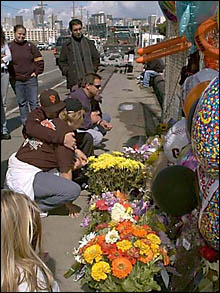 Monday's San Francisco Chronicle brings us the story of a memorial
in the parking lot of SBC Park in San Francisco, held for a young Redwood City man
who was stabbed to death following a Giants baseball game: "[Timothy] Griffith's
parents, along with dozens of relatives and friends, returned to the stadium parking
lot Sunday for a vigil. They cried and hugged, left flowers and candles, and talked
about a sensitive, funny young man who had a lot of friends rooting for him to put
his troubles behind him." A photo with the story shows a small gathering around
what the paper calls a "makeshift shrine" of balloons and flowers along
a fence near where Griffith was killed.
Monday's San Francisco Chronicle brings us the story of a memorial
in the parking lot of SBC Park in San Francisco, held for a young Redwood City man
who was stabbed to death following a Giants baseball game: "[Timothy] Griffith's
parents, along with dozens of relatives and friends, returned to the stadium parking
lot Sunday for a vigil. They cried and hugged, left flowers and candles, and talked
about a sensitive, funny young man who had a lot of friends rooting for him to put
his troubles behind him." A photo with the story shows a small gathering around
what the paper calls a "makeshift shrine" of balloons and flowers along
a fence near where Griffith was killed.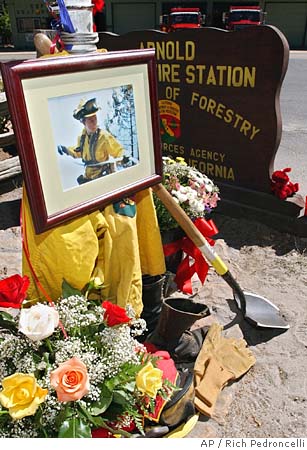 The week before, the San Francisco paper had reported on another
memorial shrine-this one in the small town of Arnold in Calaveras County, put together
for 24 year old California Department of Forestry and Fire Protection firefighter
Eva Schicke, who died in last week's Stanislaus National Forest fire: "[On]
Tuesday evening, just after dusk…candles from a roadside memorial flickered in a
cool breeze that hinted of autumn. [Fire Captain Andy] Murphy and a small group of
young colleagues stood nearby in their dark blue uniforms; their badges, adorned
with black sashes of mourning, reflected the headlights of passing cars. A bouquet
of remembrance balloons blew in front of a floodlight aimed at a flagpole where a
picture of Schicke was pinned at eye level, casting a shadow over the group."
The week before, the San Francisco paper had reported on another
memorial shrine-this one in the small town of Arnold in Calaveras County, put together
for 24 year old California Department of Forestry and Fire Protection firefighter
Eva Schicke, who died in last week's Stanislaus National Forest fire: "[On]
Tuesday evening, just after dusk…candles from a roadside memorial flickered in a
cool breeze that hinted of autumn. [Fire Captain Andy] Murphy and a small group of
young colleagues stood nearby in their dark blue uniforms; their badges, adorned
with black sashes of mourning, reflected the headlights of passing cars. A bouquet
of remembrance balloons blew in front of a floodlight aimed at a flagpole where a
picture of Schicke was pinned at eye level, casting a shadow over the group."Two California communities a long distance apart. Two tragic deaths. Two similar community shrines, as mourners spontaneously find common ways to vent their grief and to memorialize their fallen friends.
Now comes Oakland where street shrines, it seems, are no longer welcome. At least, not by the police.
On the same day as the Chronicle ran the Schicke story, the Oakland Tribune brings us a far different announcement under the headline "Shrines To Victims Are Not Long For The Streets" and the subhed "City cops seek swift removal of impromptu tributes, which chief says beget further violence": "In the wake of a shooting at a street shrine that killed an Oakland man and injured five others, police Chief Richard Word on Thursday ordered his officers to remove the impromptu memorials. Although the city and Police Department had allowed the shrines to remain on public and private property for as long as six months, the violence earlier this week prompted Word to change the policy. 'They seem to be a magnet for violence,' Word said. 'You can almost count on some sort of retaliatory violence while people are mourning at these shrines.' Word said his officers would first ask friends and family members to remove the pictures, stuffed animals and religious items. If they do not, the police will take the items and keep them until they are claimed by the family. But Word said bottles of liquor and drug paraphernalia, which are often a part of the shrines, will be thrown away. Many of the mourners have also begun spray-painting slogans of remembrance and gang graffiti around the shrines."
Keep those last two sentences in your mind-the thing about the liquor and drug paraphernalia and the spray-painted slogans-plus that interesting phrase from the chief of "you can almost count on...retaliatory violence...at these shrines." We'll talk about that when we have a little bit more time.
Anyway, according to the Tribune story, Chief Word's actions came after someone-police say they were gang members-shot at mourners at a 94th Avenue and A Street memorial shrine just two hours after shots were fired by what police say were rival gang members at a the Hayward funeral of a reported gang member. Also, the Tribune reported that the chief took these street shrine ban actions on his own, without discussions with either Mayor Jerry Brown or the Oakland City Council (the Tribune didn't mention whether he talked with City Attorney John Russo).
If the chief's policy stands, mourning street shrine memorials will be allowed all across California, presumably, but not in Oakland, where there is so much to mourn.
As always, a little further explanation is in order.
Mourning shrines became part of Oakland's street scene only relatively recently-by recently, I mean in the last 25 years. I don't remember them when I left in 1969, but by '88–when I returned from Southern exile–they were a common fact of Oakland life. Although you can never know the meaning of every gathering of flowers and stuffed animals and candles and sympathy cards sidewalk chalk drawings you pass, the shrines mostly seem to be associated with violent deaths-sometimes by gun or knife, sometimes by auto accident.
There are so many of them in such widespread locations–-and they rise so spontaneously–that like funeral rites themselves, the shrines seem to be fulfilling some necessary human function in our lives.
Perhaps part of it is accessibility. In earlier times, to paraphrase DuBois from "Souls of Black Folk", most people were born and lived and then died all in the shadow of the same hill or tree, and so their burial plot was a natural gathering point for those who were closest in their lives. In Carolina, burial plots were sometimes in families' back yards. But we are so scattered, now, in these new times. Who knows where people are buried? Who can get there, if we knew? The street shrines, at least, mark places that are in full view, where we can easily go, and pay our respects.
But the shrines also are a commentary-sometimes the family's and community's only available commentary on the manner of the death. In that way, they may be both a memorial and a protest–a crying out of "why?"–in a visible way that cannot be ignored. One the most poignant ones I remember was for a young girl who was killed by a car while walking by the public housing project on 77th Avenue and Bancroft in Oakland. I remember the shrine for the flowers and candles that stayed up for many weeks afterwards, but also for the ghastly bent railings of the project's iron fence, just behind the shrine, caused by the car after it hit the girl and, unaccountably, left unfixed by the city for months and months. That one, yes, and also the shrine on Seminary Avenue where U'Kendra Johnson died, the young Oakland High graduate who was killed when she was hit by a car with a drunk driver fleeing from a high-speed police chase.
Most of Oakland's memorial street shrines have nothing to do with retaliatory gang violence but there is nothing in Chief Word's announced statement that he is making such a differentation. We can expect, then, following the chief's orders, Oakland police officers will tear down street shrines–all street shrines–regardless of the cause of the victim's death, and regardless of whether such shrines in and of themselves are likely to lead to further violence in our streets.
Clearly, there's more to talk about, here, both by the Oakland City Council and by Oakland citizens. This is not Chief Word's decision to make on his own. No, not at all. More on this–much more–later.